


Case Study
At AAHK, we are constantly finding smarter ways to optimise our use of energy to prevent excessive use, reduce wastage and divert it to where and when it matters most. Enabled by recent technological innovations such as predictive analytics and big data, we developed unique energy management solutions to help us use energy more effectively and efficiently – such as the Weather Forecast for Air-conditioning Control System (Weather FACTS) and Battery Energy Storage System (BESS).
At AAHK, we are constantly finding smarter ways to optimise our use of energy to prevent excessive use, reduce wastage and divert it to where and when it matters most. Enabled by recent technological innovations such as predictive analytics and big data, we developed unique energy management solutions to help us use energy more effectively and efficiently – such as the Weather Forecast for Air-conditioning Control System (Weather FACTS) and Battery Energy Storage System (BESS).
AAHK has a long standing history of innovation towards energy management at the airport, and we remain at the forefront of adopting sustainable power management and energy saving technologies to enhance energy efficiency. In 2021, together with CLP Power Hong Kong (CLP Power), we jointly developed the Weather Forecast for Air-conditioning Control System (Weather FACTS) to control energy usage as environmental factors change, and the Battery Energy Storage System (BESS) to save excess energy for future use.
Weather FACTS plays it smart and cool
Weather FACTS is an automated chiller system that uses machine learning to forecast and subsequently pre-adjust the most appropriate amount of energy needed to cool the airport, based on surrounding environmental conditions. Together with two new 5,000 refrigerant tonnes chillers installed in 2021, the system has helped HKIA save an estimated 5.1 gigawatt hours (GWh) of electricity a year, equivalent to the annual energy consumption of nearly 1,200 CLP Power residential customers.
Presently in operation at HKIA’s Terminal 1, Weather FACTS has enabled us to achieve about 90% accuracy for the airport’s air-conditioning needs. It employs big data to collect hourly data including temperature, humidity, cloud amount, wind direction, wind speed and solar radiation – sourced from the Hong Kong Observatory, half-hourly electricity consumption of HKIA from CLP Power as well as HKIA’s own flight index and seawater temperature information. These data sets are used to build a big data model that can forecast the cooling demand of the passenger terminal over the following 24 hours, so the system can subsequently pre-adjust and deliver the appropriate cooling volume for maximised energy efficiency.
We are proud to be the first airport in the world to adopt a predictive control model for air conditioning. Moving forward, we will also implement the system in other passenger facilities, including the new T2 Concourse of the Three-runway System, in order to further optimise energy efficiency.
Banking with BESS for backup power
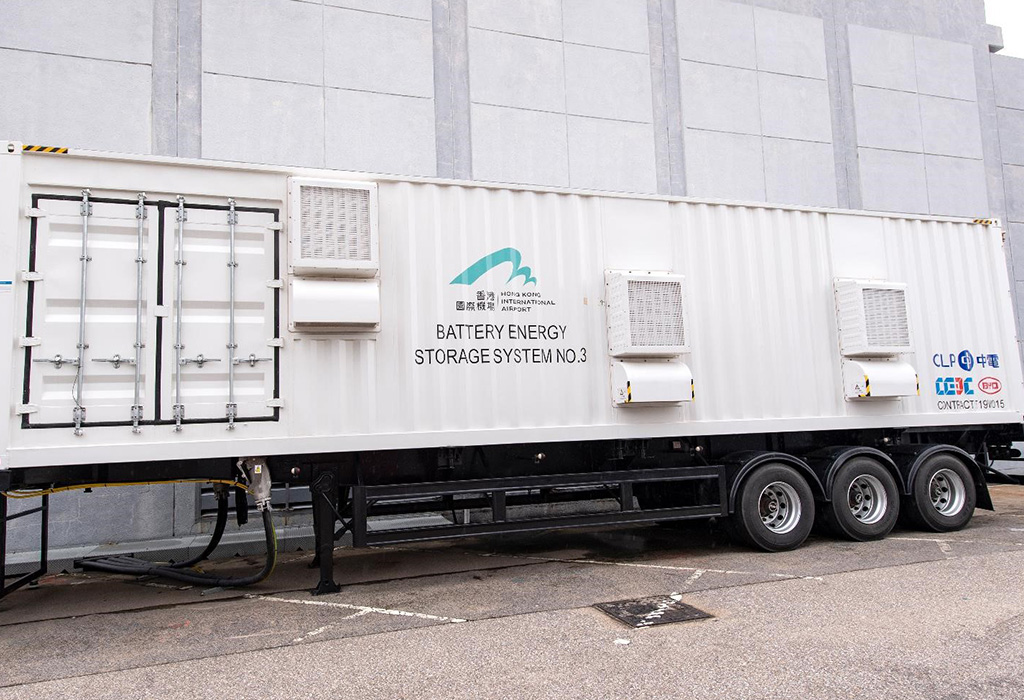
AAHK’s Battery Energy Storage System (known as BESS), jointly developed with CLP Power, is the largest battery storage system in Hong Kong to reduce electricity wastage. It works synchronously with HKIA’s six backup generators to provide backup power in the event of an emergency.
BESS’ three containers store over 400 lithium batteries for a capacity equivalent to more than 55,000 pieces of 10,000 milliamp hours (mAh) portable power banks. Each container is equipped with battery management, energy conversion, air conditioning, fire, lighting and fully automated computer control and monitoring systems. Installed in a wheeled container, the mobile design of BESS also enables the system to be deployed anywhere for emergency use. This saves construction expenses that would be incurred for expanding the current generator house.
In addition, the deployment of BESS has enabled HKIA to save electricity generated from the routine testing of backup generators at the airport every month. In the past, electricity generated during testing could not be stored; however, with the deployment of BESS, the electricity can now be saved for future use.