



Case Study
The global aviation industry, responsible for 2-3% of total greenhouse gas emissions, is under increasing pressure to decarbonise as global warming accelerates. SAF is a liquid fuel that has the potential to reduce CO2 emissions by up to 80%1, and can be produced from various sources including waste fat and municipal solid waste. Driving the advancement and adoption of SAF is a key focus for the aviation industry’s transition away from fossil fuels.
The global aviation industry, responsible for 2-3% of total greenhouse gas emissions, is under increasing pressure to decarbonise as global warming accelerates. SAF is a liquid fuel that has the potential to reduce CO2 emissions by up to 80%1, and can be produced from various sources including waste fat and municipal solid waste. Driving the advancement and adoption of SAF is a key focus for the aviation industry’s transition away from fossil fuels.
The adoption of SAF, however, faces an array of challenges including the fuel’s cost, which is currently three to four times higher than traditional kerosene2. In response, jurisdictions globally are introducing mechanisms to stimulate demand and support production, including the European Union, United Kingdom, Singapore and the United States. As these challenges are overcome, the International Air Transport Association (IATA) estimates SAF could enable 65% of the emission reductions necessary for the aviation industry to reach net-zero CO2 emissions by 20503.
Throughout 2024, AAHK worked closely with the HKSAR Government and carried out extensive stakeholder engagement to conduct a study on SAF, laying out various options to support policy development in the Hong Kong context. This work culminated in a set of strategic options to be considered by Government to drive the use of SAF in Hong Kong.
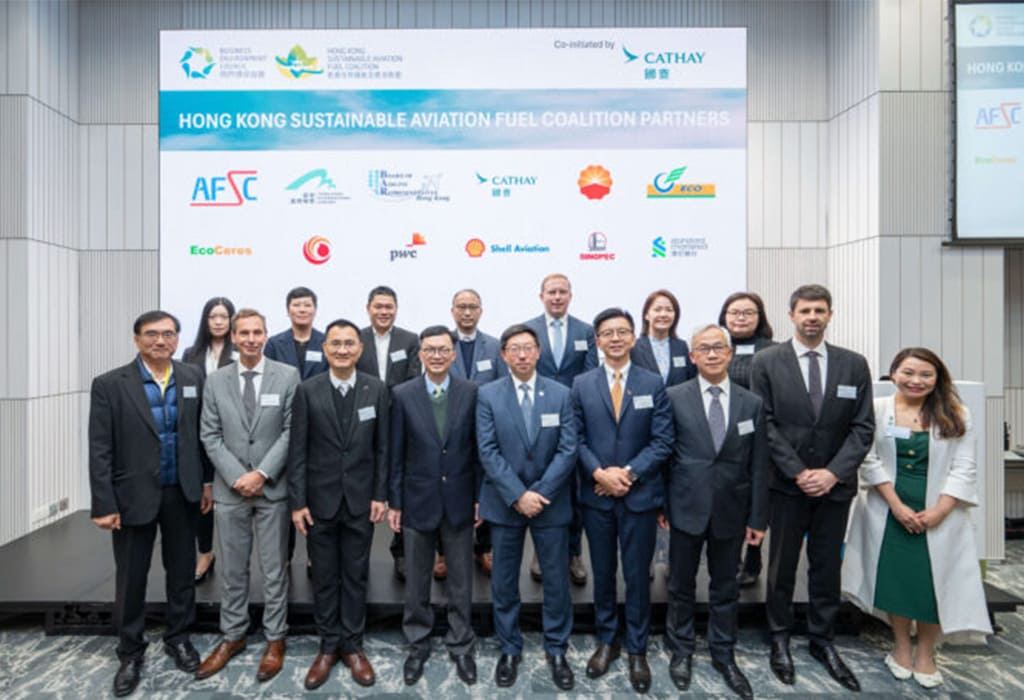
AAHK is also a member of the Hong Kong Sustainable Aviation Fuel Coalition launched by the BEC for the purposes of establishing SAF goals, commencing dialogue with the mainland on uplift strategies and raising public awareness of the SAF transition. The Coalition has been facilitating the adoption of SAF in Hong Kong by conducting whitepaper research in 2024 on SAF development, engaging with different stakeholders and the Government, and raising public awareness of the benefits and challenges of SAF. The coalition is chaired and convened by BEC and consists of 13 founding partners, including AAHK, from the SAF value chain. The participation demonstrates AAHK’s commitment to building a sustainable aviation hub and to support the use of SAF at HKIA. As a member of the Coalition, AAHK actively participates in the SAF working groups to provide insights from an airport operator perspective on SAF target setting, fuelling infrastructure and public education.
References
1 “Net zero 2050: sustainable aviation fuels” factsheet, IATA as of 1 July 2024.
2 “Making Net-Zero Aviation Possible: An Industry-Backed, 1.5°C-Aligned Transition Strategy”, Mission Possible Partnership, published in July 2022.
3 “Developing Sustainable Aviation Fuel (SAF)”, IATA webpage as of 1 July 2024.